Table of Contents
Electric vehicles (EVs) are no longer rare sights on the roads of Central Alberta. From sleek Teslas to reliable Hyundai Ioniqs and bold Ford Mustang Mach-Es, more drivers in Red Deer and beyond are embracing the EV lifestyle. It’s cleaner, it’s quieter, and let’s face it—there’s something addictive about zipping away with instant torque and no engine noise.
But there’s one big issue most new EV owners don’t realize until it’s too late: your electric vehicle needs specialized tires. And we’re not just talking about buying something “eco-friendly.” The battery weight, regenerative braking, and high torque of EVs can chew through regular tires like a snowplow on Highway 2 during a January storm.
So, let’s break down why your EV or hybrid needs the right rubber on Alberta roads—and how the right tires will keep your car running smooth, safe, and efficient.
Understanding the EV Boom in Central Alberta
There’s no denying it: Alberta is seeing a surge in EV and hybrid ownership. Red Deer, nestled between Calgary and Edmonton, is becoming a hotspot thanks to expanding charging infrastructure and provincial incentives. More residents are recognizing the long-term cost savings and environmental benefits of ditching gas.
But with this rise comes a learning curve. Traditional vehicle maintenance doesn’t always cut it for electric models. EVs aren’t just gas vehicles with batteries—they’re a different beast altogether. And nowhere is that more evident than where the rubber meets the road.
What Makes Electric Vehicles Different?
On the surface, EVs look like your average sedan or crossover. But underneath, they’re packed with new tech and engineering that fundamentally changes how they drive—and how their tires wear.
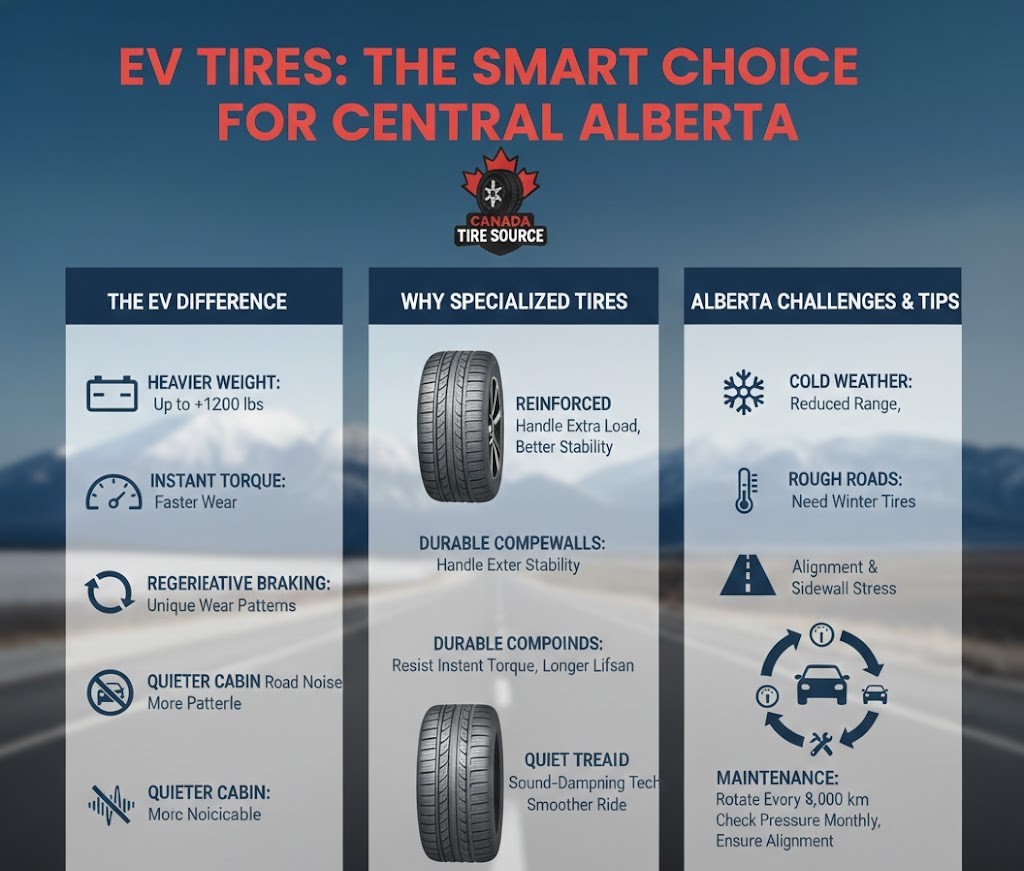
Let’s look at a few key differences:
- Battery weight: The battery pack adds hundreds of pounds, increasing the overall weight of the vehicle.
- Instant torque: Unlike gas cars, EVs deliver power to the wheels the moment you touch the accelerator.
- Regenerative braking: Braking systems that use motor resistance, rather than just brake pads, to slow down the car.
- Low cabin noise: With no engine hum, tire and road noise become more noticeable.
Each of these features has a direct impact on tire performance, meaning your EV demands more from its tires than a traditional car ever could.
Why Standard Tires Don’t Cut It for EVs
Using regular tires on an EV is like putting running shoes on a linebacker. Sure, they fit—but they’re not built for the weight or power. Standard tires wear out significantly faster when used on electric vehicles. Why?
- They’re not designed for the added load. The extra weight from the battery causes quicker tread wear, especially on the edges.
- They can’t handle instant torque. The sudden jolt of power strains the tread, leading to early degradation.
- They’re noisier. With less engine noise to mask sound, traditional tread patterns can create an annoying hum on the highway.
In short, you might save a few bucks going with off-the-shelf tires—but you’ll pay for it with poor performance, faster replacements, and a less comfortable ride.
The Role of Battery Weight in Tire Wear
EV batteries are heavy. A Tesla Model 3, for example, weighs over 4,000 pounds—hundreds more than a similar-sized gas vehicle. This extra mass doesn’t just affect acceleration or braking—it puts a constant load on your tires.
More weight means:
- Increased rolling resistance, which reduces efficiency.
- Accelerated tread wear, especially on the outer edges during turns.
- Greater stress on suspension and alignment, causing uneven wear patterns.
For drivers in Central Alberta, where long highway drives and harsh winter roads are common, this added strain can turn into a major safety issue. Reinforced tire construction becomes a must—not just for performance, but for peace of mind.
Instant Torque: The EV Superpower That Wears Tires Faster
If you’ve ever driven an EV, you’ve probably noticed the thrill of instant acceleration. You tap the pedal, and boom—you’re off. There’s no delay like in gas-powered vehicles. That’s called instant torque, and while it’s one of the coolest perks of EV ownership, it’s also one of the main culprits behind rapid tire wear.
Here’s what’s happening under the hood (or rather, under the chassis):
- Instant torque puts immediate pressure on the tire tread. There’s no gradual ramp-up of power—just full force, right away. That constant pressure eats through standard tires much faster.
- Front-wheel drive EVs feel it the most. Since the front tires handle both steering and acceleration, they often wear unevenly if not rotated frequently.
- All-wheel drive EVs also push this stress across all four tires, but that just means all of them will wear down evenly—and quickly.
In short, the adrenaline rush you get from fast acceleration comes at a cost. Specialized EV tires are designed with stronger rubber compounds that can withstand this force and keep your grip solid, even when your car’s launching like a rocket at a green light. If you love the EV driving experience, don’t let subpar tires ruin the fun—or your safety.
Why Reinforced Sidewalls Matter
When it comes to EV tire design, one of the most overlooked—but incredibly important—features is the reinforced sidewall. While it might sound technical, it’s actually pretty simple: think of it like the bones in your leg. You wouldn’t want to run a marathon with weak bones, right? Same goes for your EV tires.
Here’s why reinforced sidewalls are critical:
- They support the vehicle’s extra weight. EVs are heavier, and that weight doesn’t just sit on the tread—it presses on the sides during cornering and turns.
- They reduce the risk of blowouts. Alberta’s potholes are no joke. Stronger sidewalls mean less chance of catastrophic tire damage when you hit a rough patch of road.
- They improve stability and cornering. When you’re navigating slippery winter roads or wet summer highways, sidewall stiffness can be the difference between staying in your lane or sliding off it.
Reinforced sidewalls are basically the “core strength” of your tires, allowing them to handle heavy loads without bulging, cracking, or wearing out too quickly. For EV owners in Red Deer and surrounding areas, this is a non-negotiable.
How Regenerative Braking Impacts Tire Wear
Regenerative braking is another EV marvel. Instead of using traditional brake pads to stop your car, the motor reverses direction and slows the car while recharging the battery. It’s efficient, smart—and surprisingly hard on your tires.
Here’s what regenerative braking does to your rubber:
- It shifts the braking load from the rear to the front tires. Most regen systems are front-heavy, meaning your front tires take more abuse than usual.
- The stopping force is different. There’s less heat from brake pads but more sudden resistance from the drivetrain, which affects tread wear patterns.
- It can cause uneven wear if you don’t rotate your tires more frequently.
In a place like Central Alberta, where road conditions vary from icy backroads to clean highways, regen braking can be both a blessing and a curse. It’s amazing for extending battery life and reducing brake pad wear, but it means you need to monitor your tire condition more closely.
Regular tire rotations and pressure checks become crucial here—at least every 8,000 to 10,000 km. Keeping wear even between the front and rear tires ensures you don’t lose traction just when you need it most.
The Sound of Silence: Quiet Tread Patterns Explained
One of the biggest differences between an EV and a traditional vehicle is the sound—or lack thereof. Without a roaring engine masking other noises, your tires become the loudest part of the drive.
In fact, many first-time EV owners are shocked by how noisy tires can be at highway speeds. But it’s not the tires themselves—it’s just that, suddenly, you can actually hear them.
To combat this, tire manufacturers have developed special quiet tread patterns for EVs. These include:
- Asymmetric tread designs that reduce vibration and harmonics.
- Noise-canceling foam inserts inside the tire carcass to dampen road rumble.
- Smaller, varied tread blocks to prevent sound waves from building up.
These features work together to keep your ride whisper-silent. And in a province like Alberta, where long highway stretches are part of daily life, road noise can quickly turn a relaxing drive into a droning headache. Quiet tires mean you get to enjoy your podcasts, music—or just the peace and quiet—without any background buzz.
Tire Materials: Low Rolling Resistance vs. Durability
Let’s talk rubber. Specifically, the kind of rubber your EV tires are made from.
EVs benefit from low rolling resistance (LRR) tires, which are designed to glide over the road with minimal friction. Less friction = more battery range. But there’s a catch: the softer compounds used in these tires often wear out faster.
So, you’re faced with a trade-off:
- LRR tires: Great for range and fuel efficiency, but can wear down quickly under heavy loads or aggressive driving.
- High-durability compounds: Longer-lasting, but often add more road noise and reduce range slightly.
In Alberta, you need a balance. You want a compound that can handle:
- Summer heat and winter freeze-thaw cycles
- Gravel and rough rural roads
- Urban stop-and-go driving
Some of the best options today include Michelin’s Pilot Sport EV, Continental’s EcoContact 6, and Bridgestone’s Turanza EV—all engineered for performance and endurance.
Winter in Alberta: The EV Tire Challenge
Let’s be honest—winter in Alberta is a whole different beast. Icy roads, deep snow, freezing temperatures, and wildly fluctuating weather patterns make tire choice not just a matter of comfort, but of survival. For electric vehicle owners, the challenge gets even more complex.
Here’s what you need to know:
- EVs need winter tires designed for their unique weight and torque. That means tires with reinforced construction and specialized rubber compounds that stay pliable in freezing temps.
- Cold weather impacts EV range—and improper tires make it worse. Winter-specific EV tires are engineered with low rolling resistance to maintain range, even in extreme cold.
- Traction is king. Look for EV-specific winter tires with extra siping (tiny slits in the tread) and directional patterns that bite into snow and ice.
In Red Deer and the greater Central Alberta region, roads can go from dry to deadly slick in a matter of minutes. The wrong tires can mean the difference between controlled braking and a slide through an intersection.
Some top winter tire options for EVs include:
| Tire Model | Key Features | Ideal For |
| Michelin X-Ice Snow EV | Quiet ride, excellent grip, optimized for EVs | Urban commuting and highway |
| Nokian Hakkapeliitta R5 EV | Exceptional ice grip, high durability | Rural and extreme winter roads |
| Bridgestone Blizzak LM005 | Superior snow traction, short stopping distances | Mixed city and winter highway |
Make no mistake—investing in the right winter tires can save your life. It’s that serious. And since many EVs use regen braking that’s less effective on ice, having grip you can trust is non-negotiable.
How Alberta Roads Affect EV Tires
If you’ve driven much around Alberta, you already know: our roads are not gentle on vehicles. From cracked pavement in older neighborhoods to gravel roads in rural areas, your tires are constantly under siege—and if you drive an EV, you’re facing even more pressure.
Here’s how Central Alberta roads take a toll:
- Potholes and frost heaves are more than just uncomfortable—they can blow a sidewall or knock your alignment out in a heartbeat.
- Rural roads, often gravel or partially paved, lead to punctures and premature wear if you’re not on the right tread.
- Temperature swings, from -30°C to +5°C in a day, affect tire pressure and performance more than most realize.
EV-specific tires are designed with tougher rubber compounds and reinforced construction, which helps mitigate these effects. And while no tire is immune to a massive pothole, a well-made EV tire will absorb shock better and resist cracking or blistering.
Bottom line? Driving an EV in Alberta without specialized tires is like showing up to a rodeo in flip-flops—just not a good idea.
Best EV Tire Brands Available in Alberta
Let’s get practical. You want to upgrade your EV tires—what should you actually buy?
Here are some top-performing EV tire brands and models, widely available across Alberta:
| Brand | Model Name | Key Strengths | EV Compatibility |
| Michelin | Pilot Sport EV / X-Ice EV | Quiet, efficient, EV-optimized compounds | Tesla, Hyundai, Kia, more |
| Continental | EcoContact 6 / PureContact EV | Low resistance, great wet traction | Most sedans & crossovers |
| Bridgestone | Turanza EV / Blizzak EV | Comfort, long life, winter traction | SUVs and all-wheel EVs |
| Nokian | Hakkapeliitta R5 EV | Winter beast, strong for rural areas | Northern drivers |
| Pirelli | P Zero Elect | High performance, quiet, premium ride | Performance EVs |
Most major tire centers in Red Deer and nearby cities stock these or can order them quickly. Local retailers also understand the climate-specific needs here, so they’re often the best people to ask for recommendations based on your driving style and typical routes.
And yes—you can buy EV tires online. But unless you know exactly what you need, getting hands-on help locally can save you from a costly mistake.
How to Extend the Life of Your EV Tires
Tires aren’t cheap. Especially not EV-rated ones. So if you want to get the most mileage (literally) out of your set, here are some practical tips:
- Rotate regularly. Every 8,000 to 10,000 km, no exceptions. This evens out the unique wear patterns caused by instant torque and regenerative braking.
- Keep tire pressure in check. Fluctuations due to temperature changes can cause premature wear. Check monthly, especially during season changes.
- Get wheel alignments. Alberta roads can knock your suspension out of line fast. Misalignment = uneven wear.
- Avoid jackrabbit starts. It’s tempting to mash the accelerator for that instant torque thrill, but it eats your tread.
- Use dedicated winter and summer tires. All-seasons are a compromise that wear out faster under Alberta’s extremes.
Small habits go a long way—especially when each tire costs upwards of $200 to $400. Treat them right, and they’ll return the favor with longer life, better performance, and increased safety.
When to Replace EV Tires: Signs to Watch For
So how do you know when it’s time to swap out those tires? EV tires don’t always show wear the same way gas car tires do. Because of the regenerative braking and added weight, you need to watch closely for:
- Uneven tread wear, especially on the front tires
- Tread depth below 4mm—less traction and longer braking distance
- Excess road noise, a sign of worn rubber or damage
- Poor range—as tires degrade, rolling resistance increases
- Pulling to one side, suggesting alignment or tire integrity issues
A good rule of thumb: have your tires inspected by a professional every 10,000 km. And if you ever feel unsure—trust your gut. Better to replace a tire early than deal with a dangerous blowout at highway speeds.
Conclusion: Investing in the Right Tires for Your EV
Owning an electric vehicle in Central Alberta is a smart move. Lower fuel costs, cleaner emissions, and cutting-edge technology all make for a futuristic driving experience. But that future falls flat without the right tires beneath you.
From heavy battery loads to instant torque, and from frigid winters to unpredictable rural roads, your EV faces challenges gas-powered cars don’t. Specialized tires aren’t a luxury—they’re a necessity.
The good news? The market is ready. Whether you’re cruising around Red Deer in a Nissan Leaf or heading to Calgary in a Model Y, there are EV-rated tires out there built to handle it all—quietly, efficiently, and safely.
So next time your tread’s looking thin or winter’s around the corner, don’t just grab whatever’s on sale. Ask the right questions. Demand EV compatibility. And make sure the tires under your vehicle are up to the task.
Your EV deserves it. And so do you.
FAQs
1. Can I use regular tires on my electric vehicle?
Technically, yes—but it’s not recommended. Regular tires wear out faster on EVs and can negatively impact safety, range, and ride comfort.
2. How often should I rotate my EV tires?
Every 8,000 to 10,000 kilometers. EVs experience uneven wear due to instant torque and regenerative braking.
3. Are EV-specific tires more expensive?
Yes, typically 10–20% more. But they last longer, perform better, and offer a quieter ride, especially on Alberta roads.
4. What’s the best tire pressure for EVs in cold Alberta winters?
Always follow the vehicle manufacturer’s recommendations, but check weekly in winter. Cold air reduces pressure fast, impacting traction and range.5. Do hybrid vehicles need the same tires as fully electric cars?
Not always. Hybrids are generally lighter, but many still benefit from reinforced, low rolling resistance tires—especially plug-in hybrids (PHEVs).